

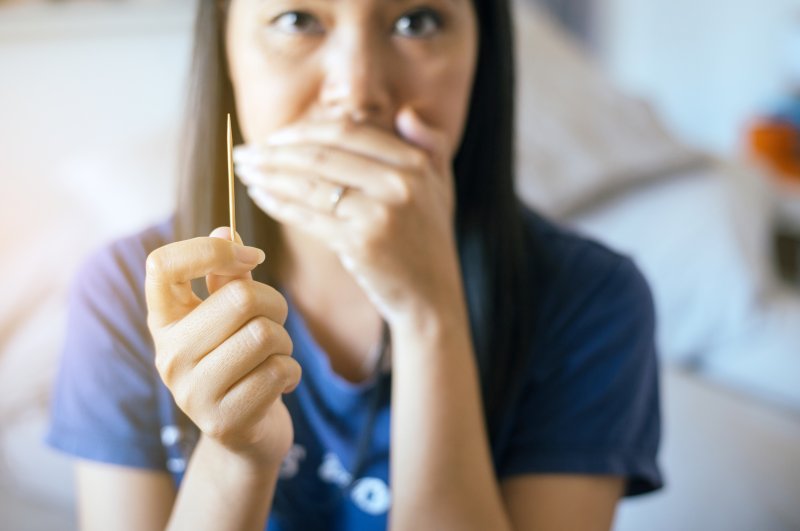
A small dispenser of wooden toothpicks sits beside the cash register in almost every classic American diner. For generations, reaching for one after a hearty meal has felt like second nature. When a stubborn shred of steak or a popcorn kernel wedges painfully between your molars, that slender, tapered sliver of birch provides immediate, tactile relief. It feels intuitive, convenient, and undeniably satisfying.
Yet from the perspective of dental anatomy, inserting a rigid, sharpened piece of wood between your teeth is roughly equivalent to using a screwdriver to clean delicate watch gears. While toothpicks have been used by humans for thousands of years, modern dentistry has revealed that this routine habit often creates far more damage than the food debris it was meant to dislodge.
The risks associated with picking your teeth go far beyond an accidental jab to the cheek. Chronic toothpick use can irreversibly degrade soft tissue, compromise expensive restorations, and invite serious bacterial infections into the deeper structures of your jaw.
The Fragile Architecture of the Interdental Space
To understand why toothpicks cause harm, one must appreciate the anatomy of the space they invade. The crevice between two adjacent teeth is not an empty, durable gap; it is occupied by a delicate pyramid of gum tissue known as the interdental papilla.
This specialized soft tissue forms a tight collar around the base of each tooth, sealing off the underlying alveolar bone and periodontal ligament from oral bacteria. It is vascular, sensitive, and held in place by fine collagen fibers that anchor directly into the root surface. Unlike the skin on your hands, the interdental papilla cannot develop protective calluses. When subjected to repetitive mechanical force, it does not toughen up—it breaks down.
Furthermore, the sides of your teeth that face each other are naturally contoured. They curve inward and outward, creating complex surfaces that cannot be safely navigated by a straight, inflexible wooden stick. Forcing a rigid object into this tight anatomical junction puts excessive pressure on tissues that were never designed to bear it.
Mechanical Trauma and Irreversible Gum Recession
The most immediate danger of using a toothpick is acute laceration. A momentary slip of the hand or an aggressive push can slice the tip of the papilla, causing immediate bleeding. While a minor cut in the mouth usually heals within a few days, repeated trauma causes chronic inflammation.
When gum tissue is persistently bruised or gouged, the body initiates a protective remodeling process. The damaged tissue gradually recedes, shrinking away from the source of chronic injury. This leads to the permanent loss of the interdental papilla, creating what dentists refer to as black triangles—unsightly dark gaps between the bases of the teeth.
Once an interdental papilla recedes, it rarely regenerates on its own. Rebuilding lost interdental tissue through surgical grafting remains notoriously difficult and unpredictable. Worse still, these newly formed gaps create larger traps for food debris, tempting you to use a toothpick even more frequently and accelerating a destructive cycle.
The Risk of Wood Splinters and Subgingival Infections
Wooden toothpicks are inherently brittle. As they absorb saliva, the cellulose fibers soften and fray under the pressure of being wedged against dense tooth enamel.
Microscopic splinters often shear off unnoticed, lodging beneath the gumline inside the periodontal pocket. The mouth is home to hundreds of bacterial species, and a porous, jagged fragment of wood provides an ideal foreign surface for microbial colonization.
Once trapped below the gumline, a splinter triggers a severe foreign body reaction. The immune system rushes white blood cells to the area, resulting in swelling, throbbing pain, and localized pus formation known as a periodontal abscess. In severe cases, treating an embedded splinter requires a dental provider to numb the area, surgically open the gum tissue, and manually debride the pocket to prevent deep bone loss.
Structural Damage to Enamel, Roots, and Restorations
Tooth enamel is the hardest substance in the human body, but it is not invulnerable to sustained friction, nor does it extend down the entire length of the tooth.
Abrasion Along the Vulnerable Root Margin
Near the gumline, enamel tapers off to meet the cementum, a much softer, calcified tissue that coats the roots. When gum tissue recedes even slightly, the cementum becomes exposed to the oral cavity.
Aggressive, repetitive scraping with a hard toothpick wears down this soft outer layer, forming notches along the root surface. This non-carious cervical abrasion exposes the underlying dentin, which contains thousands of microscopic tubules leading directly to the tooth’s nerve. The result is sudden, acute hypersensitivity to cold drinks, hot foods, and sweet treats.
Fracturing and Dislodging Costly Dental Work
If you have dental restorations—such as composite fillings, porcelain crowns, inlays, or cosmetic veneers—using a toothpick becomes exceptionally risky.
Restorations are secured to natural tooth structure along microscopic margins. Forcing a toothpick into the interproximal area can catch these edges, exerting prying leverage on the dental cement. Over time, this mechanical wedging can chip fragile porcelain, break composite margins, or loosen a permanent crown entirely. A broken restoration seal allows bacteria to slip beneath the crown, sparking recurrent decay that can destroy the remaining natural tooth structure unnoticed.
The Wedging Effect: Creating Unwanted Tooth Movement
Teeth are not fused directly into the jawbone like posts set in concrete. Instead, they are suspended inside their bony sockets by the periodontal ligament, a dynamic network of tiny shock-absorbing fibers. This ligament allows teeth to make micro-movements during chewing.
Habitually wedging a thick wooden toothpick between the same two teeth acts as a mechanical lever. If done repeatedly, this constant outward pressure can actually move the teeth slightly apart. This subtle orthodontic shifting widens the contact point, creating an open space that catches even more fibrous food every time you eat. What began as a minor nuisance becomes a permanent anatomical food trap created entirely by the tool used to clear it.
The Illusion of Effective Oral Hygiene
Perhaps the most insidious danger of the toothpick is psychological: it provides a misleading sense of cleanliness.
When you pop out a visible chunk of meat or a vegetable fiber, your tongue feels immediate relief, leading you to believe that the space between your teeth is clean. In reality, oral health is threatened far more by microscopic plaque biofilm than by macroscopic food chunks.
Plaque consists of an organized, sticky layer of bacteria that coats the proximal surfaces of the teeth. Because a toothpick is flat or round and utterly rigid, it can only make point contact with a curved tooth. It cannot conform to the concave contours of the enamel, meaning it leaves the majority of the pathogenic biofilm untouched. Relying on toothpicks as a substitute for proper interdental hygiene allows interproximal cavities and silent periodontitis to develop beneath the surface.
Safer, Clinically Proven Alternatives
Retiring the wooden toothpick does not mean you have to endure the discomfort of trapped food. Modern oral hygiene offers several tools that clear food and plaque without endangering your delicate tissues.
-
Waxed dental floss and PTFE tape: Traditional floss remains the gold standard because of its flexibility. When curved into a “C” shape against the side of a tooth, floss wraps around anatomical contours, gently sweeping away plaque below the gumline without cutting the papilla.
-
Interdental brushes: For individuals with wider spaces or mild recession, tiny cylindrical brushes featuring soft nylon bristles wrapped around a plastic-coated wire are vastly superior to wood. They fill the space, scrub the curved walls clean, and bend safely without fracturing.
-
Water flossers: Using a pulsed stream of pressurized water, oral irrigators flush out trapped food particles and disrupt subgingival bacteria effortlessly, making them an ideal choice for people with dental implants, bridges, or sensitive gums.
-
Soft rubber picks: If you crave the tactile convenience of a portable pick, opt for modern elastomeric picks. These feature soft, flexible rubber tips that massage the gums and dislodge debris without splintering, abrading root cementum, or applying dangerous wedging forces.
A wooden toothpick may seem like a timeless, harmless convenience, but your mouth pays a steep price for its crude simplicity. Trading that splinter-prone relic for dedicated, modern interdental tools is a small adjustment that will protect your gums, preserve your restorations, and safeguard your smile for years to come.
Meta Title:

Comments are closed.