

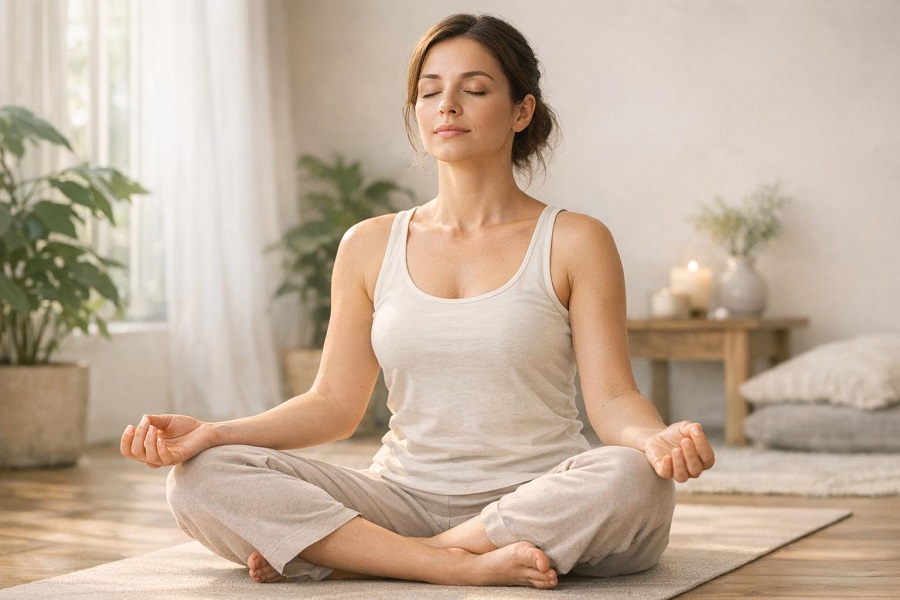
When newcomers sit down to meditate, they frequently carry an impossible expectation: the belief that their minds should suddenly fall silent like an empty auditorium. Within sixty seconds, an avalanche of grocery lists, unresolved workplace conversations, and nagging physical aches bursts through the quiet. Frustrated, many walk away convinced they lack the temperament or mental discipline required for contemplative practice.
The issue rarely stems from an unruly mind. Rather, it comes from attempting to anchor attention to an abstraction. Telling yourself to simply clear your thoughts offers the conscious mind nothing tangible to hold onto. This is precisely why mindful breathing has served as the bedrock of contemplative disciplines across centuries and cultures. The breath is neither an abstract philosophy nor an artificial prop; it is an intimate, ever-present physiological rhythm that bridges conscious intention with involuntary biological function. When you understand how to use it, respiration ceases to be background noise and becomes an unbreakable anchor for mental clarity.
The Neurological Bridge Between Breath and Calm
To appreciate why breathing serves as such an effective meditative foundation, one must examine its relationship with the autonomic nervous system. Respiration occupies a unique position in human biology: it is one of the few vital functions that operates completely automatically yet remains accessible to voluntary control. You can consciously accelerate your breathing, hold it, or slow it down, but the moment your attention shifts elsewhere, your brainstem seamlessly resumes control.
This dual nature makes the breath a direct lever on your physiological state. When psychological stress activates the sympathetic branch of the nervous system—the classic fight-or-flight mechanism—your breathing patterns reflexively turn shallow, rapid, and concentrated in the upper chest. By intentionally extending your exhalations and allowing the diaphragm to move freely, you stimulate the vagus nerve. This physical feedback signals the brain that immediate danger has passed, activating the parasympathetic response, which slows the heart rate, relaxes peripheral blood vessels, and eases neurological agitation.
Mindful breathing does not always require altering your rhythm. Even the neutral, unforced observation of your natural respiration interrupts the brain’s default mode network—the neural circuit responsible for anxious mind-wandering, self-referential rumination, and chronic future-planning. By anchoring awareness to real-time physical sensations, you gently pull the brain out of defensive cognitive loops.
Pinpointing Your Somatic Anchor
A common pitfall in meditation is treating the breath as an abstract idea rather than an immediate tactile reality. You do not meditate on the intellectual concept of breathing; you meditate on the physical sensation of air moving across nerve endings in real time.
Every individual experiences respiration differently, and discovering your personal anchor is the first step toward building a stable habit. When you sit comfortably with an upright, relaxed spine, scan your torso to notice where the movement of your breath feels most distinct:
-
The rim of the nostrils: For many, the sensation is clearest at the base of the nose and across the upper lip. You might notice a faint coolness on the inhalation and a subtle warmth on the exhalation.
-
The rise and fall of the chest: Focusing on the expansion and contraction of the rib cage provides a broader, rhythmic anchor that grounds people who find fine-point nasal sensations too subtle to follow.
-
The expansion of the abdomen: Following the outward push and gentle release of the belly engages the lower diaphragm and encourages full somatic relaxation.
Once you identify where the physical sensation is most vivid and effortless to track, commit to that single location for the duration of your session. Bouncing your attention between your nose, your ribs, and your stomach introduces unnecessary mental restlessness. Anchor your awareness in one spot, treating it like a lighthouse that marks your point of return whenever mental fog rolls in.
Simple Methods to Cultivate Breath Awareness
Developing an enduring relationship with your breath does not require elaborate rituals or rigid formulas. Two straightforward techniques provide sufficient structure to stabilize attention without creating mental fatigue.
The Unfiltered Observation Method
The most fundamental approach involves relinquishing the desire to control your breathing altogether. In this practice, you make no effort to breathe deeply, slowly, or rhythmically. If the breath is shallow, you simply notice its shortness; if it is rough or uneven, you observe that texture without attempting to fix it.
The primary hurdle here is resisting the subconscious urge to manage the process. Many people find that the moment they direct their attention toward breathing, they begin forcing performative deep breaths. Treat your awareness like an observer resting on the bank of a river. You are not pushing the water or altering its course; you are merely watching the current move. This cultivates psychological neutrality and dampens the habit of constantly managing your internal experience.
Controlled Anchoring Through Breath Counting
On days when the mind feels particularly turbulent, passive observation may feel too slippery to hold your focus. In these instances, introducing a light counting framework provides just enough mental engagement to keep attention from drifting away.
As you complete a full cycle of inhalation and exhalation, mentally note the number one. On the following exhalation, note two. Continue this steady progression until you reach ten, and then deliberately restart at one. If you notice your mind has wandered and you have counted past ten—or drifted into a daydream at number four—simply acknowledge the departure without frustration and gently restart at one. The number is not a score or a test of skill; it is merely a handrail that keeps you from slipping into unconscious distraction.
Navigating Mental Drift Without Frustration
The primary reason practitioners abandon meditation is the mistaken belief that experiencing distraction equates to failure. You will sit down, anchor your awareness to the movement of your chest, and within thirty seconds find yourself replaying an uncomfortable conversation from three days ago or worrying about an upcoming deadline.
This drift is not evidence of a broken practice; it is the universal nature of the human brain. The true turning point in any meditation practice occurs at the precise moment you realize your attention has wandered.
In that single second of recognition, conscious awareness returns. You have stepped outside of the daydream to observe that you were dreaming. If you respond to that moment with irritation or self-criticism, you introduce emotional tension that disrupts your focus further. If, instead, you greet that realization with neutral curiosity and escort your focus straight back to your chosen breathing anchor, you have performed a successful mental repetition. Over weeks and months, these patient returns physically strengthen your attentional control and build emotional resilience.
Integrating the Anchor into Everyday Life
Confining mindful breathing to a quiet bedroom or a meditation cushion misses its greatest practical value. The ultimate purpose of seated practice is not simply to enjoy twenty tranquil minutes in isolation, but to build a responsive reflex you can deploy during moments of friction.
Life routinely pulls you off balance: an abrasive email from a colleague, unexpected gridlock during a morning commute, or the ambient sensory overload of a hectic afternoon. In those moments, you do not need to close your eyes, cross your legs, or retreat to a silent room.
All that is required is three conscious, unhurried breaths. Feel the physical weight of your feet against the floor, track the air entering your nostrils, and allow the exhalation to soften the tension held across your shoulders and jaw. That brief, ten-second pause breaks the momentum of automatic reactivity, granting you the clarity to respond with intention rather than impulsive emotion.
Meditation does not require transforming yourself into an ascetic or mastering complex theoretical systems. It asks only that you develop an honest, patient relationship with the rhythm already sustaining you. By honoring your breath as a reliable, portable foundation, you build an internal steady point that remains accessible wherever you go.

Comments are closed.